
OK so I said my next blog post was going to be about my aviation photography… But stuff happens !!
During my time working at Google, we used to describe Google Earth and Maps as a mirror of the real world.
It wasn’t just a marketing slogan; it was a guiding principle. To us, the earth-observation and geospatial teams, the core value proposition of Google Earth was objective truth. It was a digital double of our planet built on photons bounced off satellites, stitched aerial photography, and meticulously modeled 3D geometry. If you zoomed into a street corner in Tokyo, a rural farm in Kansas, or Teddington High Street, you trusted that what you were looking at actually existed.
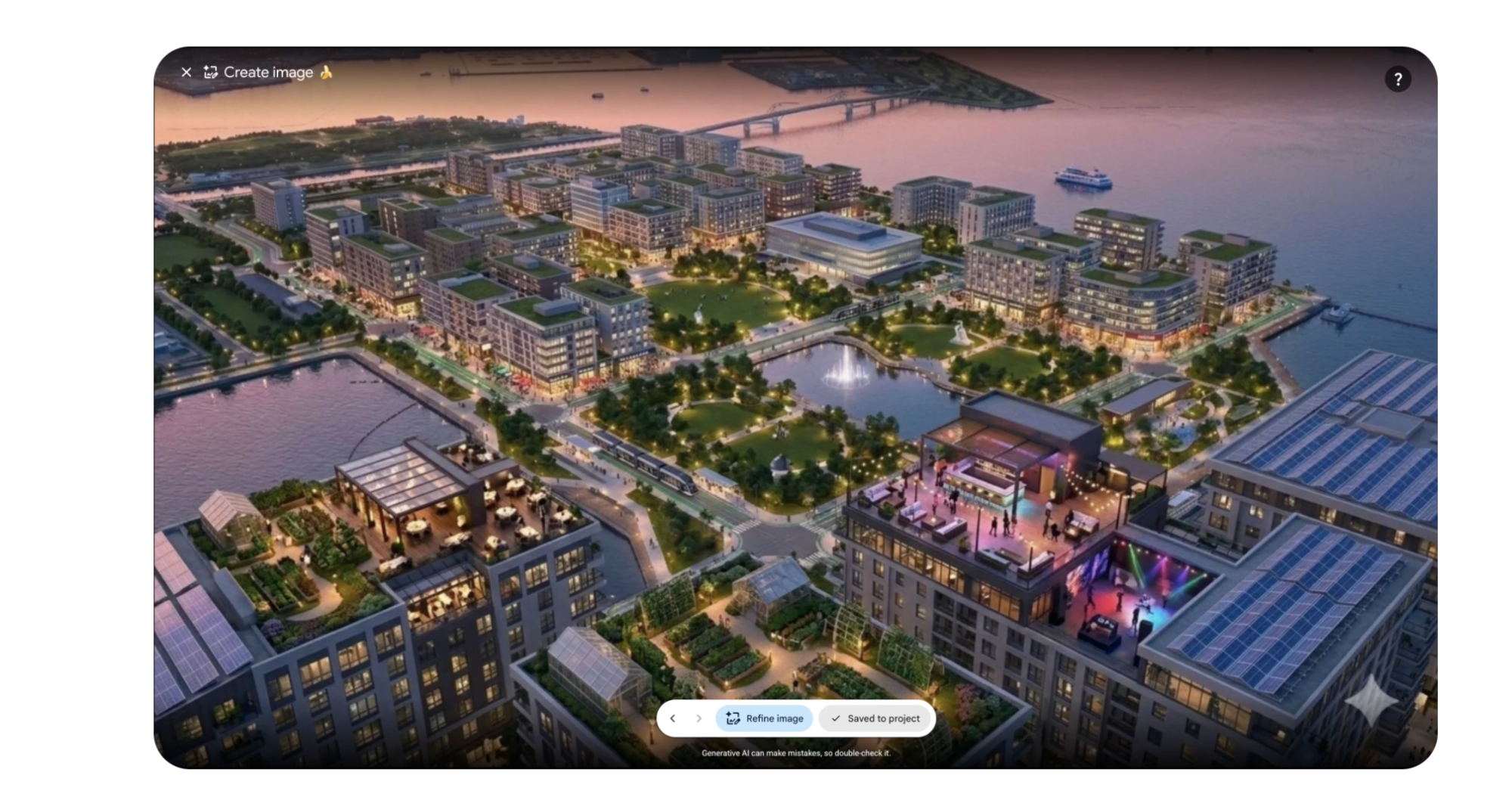
That absolute bedrock of trust was structurally shattered this week—briefly, thankfully, but dangerously—when Google rolled out (and subsequently had to reverse) its “Nano Banana 2” AI image generation feature directly inside Google Earth.
Yes, you read that right. A feature named after a fruit was unleashed to let users paint synthetic, hallucinated realities straight onto the planet’s trusted baseline layer.
The “Nano Banana” Blunder: When a Mirror Becomes a Magic Eye Poster
The pitch from the product team was dripping with standard Technical Product Manager buzzwords. They wanted to help users “visualise the past,” dream up real estate projects, or see what an empty lot might look like as a community garden.
Sounds harmless enough in a vacuum, right or on your desktop GIS system?
Except the internet immediately did what the internet always does when handed a frictionless tool for synthetic fabrication. Within hours of launch, researchers, OSINT investigators, and digital watchdogs began using Nano Banana 2 to drop fake refugee crises at borders, plant nuclear power plants in restricted zones, and simulate fatal crashes or geopolitical flashpoints on real streets.
Because the resulting screenshots maintained the authoritative interface of Google Earth, they could easily be weaponized as pristine disinformation. By July 31st yes that’s just yesterday !—barely 24 hours after shouting about how users could now render ancient Pompeii or futuristic sci-fi utopias—Google was forced to retreat, pulling the feature and admitting they needed to work on “stronger guardrails”.
How did a company that once deeply respected the sanctity of geospatial truth sign off on something so fundamentally reckless?
How did a company that once deeply respected the sanctity of geospatial truth sign off on something so fundamentally reckless?
The Perverse Mandate: “Add AI to Everything”
We are living through a corporate panic. In boardrooms across Silicon Valley, leadership is terrorized by the prospect of being left behind in the generative AI gold rush. The mandate from the top has devolved into a blunt directive: Add AI to everything, everywhere, immediately. I felt this at the end of my time at Google I can only imagine how much stronger this has become..
It doesn’t matter if the product calls for it. It doesn’t matter if the product’s entire historical equity is built on being an objective record of reality. If a product doesn’t have a generative text-to-image prompt box slapped onto it, senior leadership panics.
In their haste to check an AI box, the architects of this feature completely lost sight of what makes Google Earth valuable. Google Earth is not a canvas for creative writing; it is a reference library. You don’t want an AI “interpreting” or “reimagining” a map any more than you want an AI to creatively hallucinate your bank statement.
A Total Amnesia of “Geo” Values
OK this sounds like the rantings of someone who used to work for Google Geo of course, but I believe this blunder also points to a deeper cultural rot within the current configuration of the company: a severe lack of institutional memory.
When you cycle through staff, or when leaders who have no foundational background in Geo-products are handed the keys to legendary mapping infrastructure, you get a profound disconnect. New arrivals to the Geo team saw Google Earth as a static UI waiting to be “unlocked” by generative media. They treated it like a blank social media feed.
Veterans of the Geo organization understood an unwritten rule that took decades to build: Geospatial trust is hard to win and terrifyingly easy to lose. Google Earth is relied upon by human rights investigators, journalists, emergency responders, and courts of law as a baseline truth layer of our planet. Once you train the public to accept that the satellite view can be whimsically altered by typing a prompt about a “lakeside cabin” or a “futuristic metropolis”, you destroy the integrity of the platform. If anything on the screen can be AI-generated, then nothing on the screen can be trusted.
The Mirror Can Never Be Unbroken Entirely
Google’s quick rollback of Nano Banana 2 is a welcome relief, but the damage to the narrative is already done. The genie is out of the bottle. Bad actors have already captured screenshots, and the illusion of Google Earth as an trusted, objective mirror of the world has a permanent crack in it.
If Google wants to retain any remaining credibility for Google Earth, leadership needs to stop treating its core products as testbeds for whatever experimental model management wants to hype next.

Google remains a trustworthy company, however the technology deployed is not Google’s alone and there are other organisations who would use this capability for their own goals, this is a wake up call to the industry to be careful what you trust when it comes to Geospatial as much as Social Media these days.
keep the hallucinations out of the geography
Some things in this world should remain real. Leave the bananas in the fruit bowl, and keep the hallucinations out of the geography.
And now Google are getting rid of Google Earth Pro, adding insult to injury and the despair of hundreds/thousands of users