
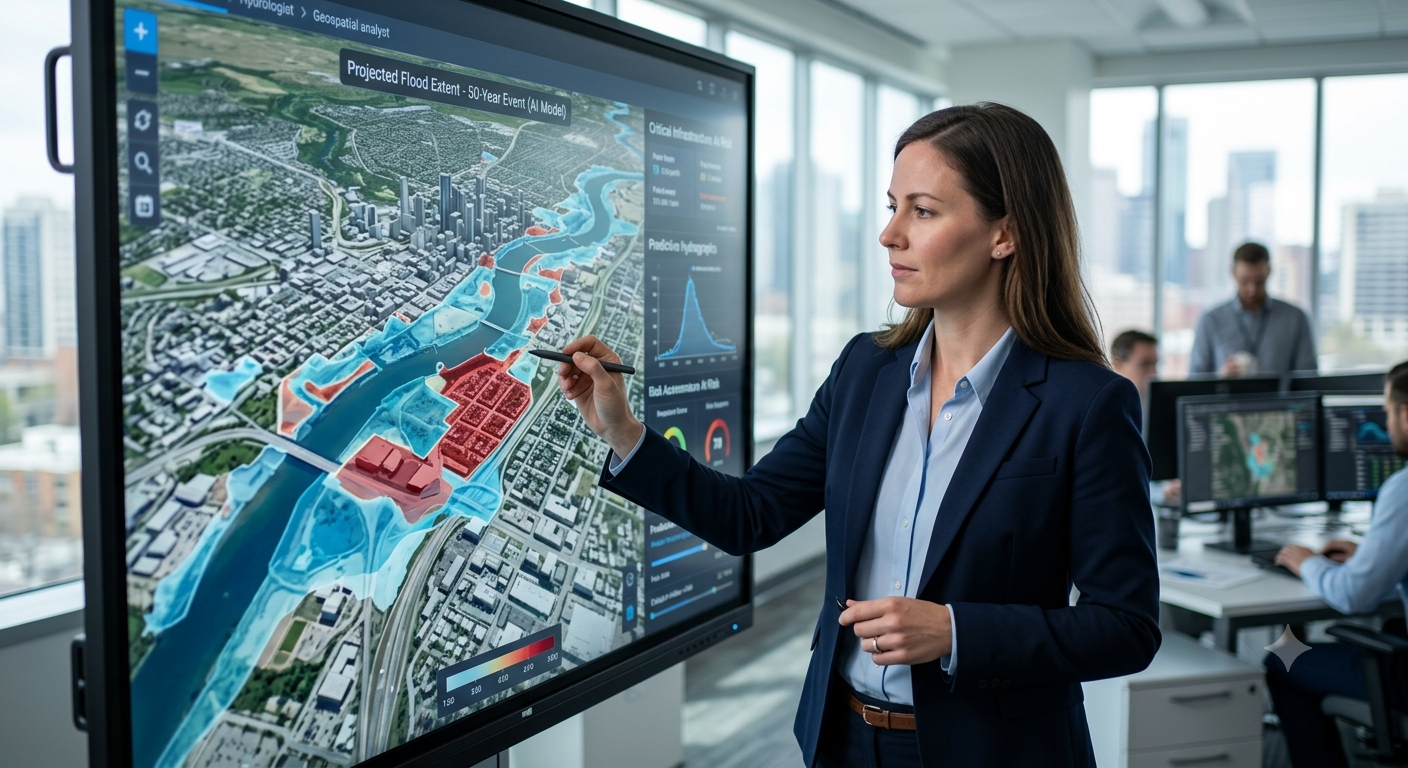
Who else got into geography to change the world rather than just digitise it?
If you read Rohan Silva’s recent essay in The Times, you’ll have seen him articulate a shift that is quietly rewiring the way we think about knowledge work. Silva captures a profound transition brought on by the rise of Artificial Intelligence: we are moving away from a world defined by mastering the how, and entering a world where value is entirely driven by the what.
Reading his piece, I couldn’t help but reflect on how perfectly this mirrors the evolution—and the immediate future—of our own geospatial industry.
For decades, to be a “Geographer” or a geospatial professional meant acting as a gatekeeper of the how. If a city planner, a climate scientist, or a logistics manager wanted to understand the spatial dynamics of their problem, they had to come to us. And our work was intensely mechanical. We spent our days wrangling shapefiles, fighting with map projections, writing complex SQL queries, and navigating the Byzantine user interfaces of desktop GIS software.
The barrier to entry for spatial analysis wasn’t the ability to think spatially; it was the ability to operate the machinery. We were defined by our technical execution.
AI is dismantling that barrier, and it is doing it faster than many in our industry realise, a point made forcefully by Peter Rabley at this year’s GeoIgnite.
With the advent of large language models and generative AI, the mechanics of spatial analysis are being abstracted away. We are rapidly approaching a point where a user can simply look at a map and ask, in plain English: “Show me the neighborhoods with the highest density of elderly residents that are also within a 100-year flood zone, and highlight the ones lacking accessible public transit.”
The AI will write the query, fetch the data, perform the intersection, and render the visualization. The machine handles the how.
For some in the geospatial community, this feels like an existential threat. If a machine can run a spatial buffer and render a heat map in three seconds based on a voice prompt, what is the role of the GIS analyst?
But as Silva’s essay implies, this isn’t the end of our profession—it is a massive elevation of it. By stripping away the friction of the how, AI frees geographers to focus entirely on the what.
When the mechanics of map-making are automated, the true value of a Geographer is revealed. Our expertise was never really about knowing which buttons to click in a software package; it was about understanding the world as a complex, interconnected spatial system.
In the AI era, our job shifts from being operators of software to being interrogators of data.
- What are the ethical implications of the spatial models we are building?
- What context is the AI missing about this local community?
- What are the systemic spatial inequalities—in health, climate vulnerability, or infrastructure—that we should be pointing these powerful new tools toward?
AI doesn’t know what questions are worth asking. It doesn’t possess geographical curiosity. It doesn’t understand the lived reality of a neighbourhood, the historical context of a border, or the nuances of human geography.
We are moving from a paradigm of spatial mechanics to one of spatial strategy. AI is finally allowing us to put down the digital spanners, look up from our screens, and focus our energy on what we are actually trying to solve. For anyone who got into geography to change the world rather than just digitise it, this is exactly where we want to be.
Next month’s blog post will be all about my other passion.. aviation photography, it’s the holiday season after all !
Concurred!. In an era where AI seems a threat to many occupations, it’s only highlighted the importance of geospatial.
My opinion is that geographers were already (and likely better) postured for the AI revolution. Building products from machine learning, big data wrangling, and multi-fusion analysis were already a pulse in the geo communities long before LLMs hit the ground. In fact, even the complex process of how these models ‘think’ is eerily similar to how a geographer comes to a conclusion.
Well said Ed. Lots of folks seem to think if they object loudly enough AI will beat a retreat. That’s not how profound technological evolution works.